- American Renaissance Minerals, a dedicated vehicle owned by US natural resources private equity firm American Renaissance Resources, is advancing the Nkamouna Cobalt-Nickel-Manganese Project in Cameroon, and is working with the Government of Cameroon toward the award of a new mining permit over the project, free of prior encumbrance.
- Nickel and cobalt are both designated critical minerals by the United States, which imports approximately three quarters of the cobalt it consumes and, excluding recycled material, is almost wholly reliant on imports for its nickel supply.
- ARM’s development of Nkamouna is supported by the advocacy program of the United States Government, and the project is regarded as being of strategic interest to the United States, both in national security terms and as a matter of economic and supply-chain interest.
- Significant capital has been invested in Nkamouna to date, including feasibility-level engineering, metallurgical testwork and environmental and social studies, providing a substantial technical base from which to restart the project.
- Aeternum Resources will contribute capital and engineering expertise to the development of the project.
- In January 2026, ARM licensed the entirety of the historical technical information relating to Nkamouna from Geovic Ltd, the majority owner of the prior permit holder, on terms under which Geovic will release all claims in respect of the project.
- The project will be developed in accordance with Cameroon’s Mining Code of December 2023, including the 10% free-carried interest of the State, with a concentrator at the mine site producing an exportable cobalt-nickel-manganese concentrate rather than shipping unprocessed ore.
PR Audio:
Washington D.C., August 7, 2026 – PRISM MediaWire (Press Release Service – Press Release Distribution) – Aeternum (OTC: AETN) (“Company”), a company aiming to become a highly strategic supplier of critical minerals, today announced that it has acquired an option to acquire a 51% stake in American Renaissance Minerals (“ARM”). ARM, a dedicated vehicle owned by US natural resources private equity firm American Renaissance Resources, is advancing the Nkamouna Cobalt-Nickel-Manganese Project in Cameroon. The project is aligned with the Company’s objective of becoming a significant supplier of critical minerals to the United States and its allies.
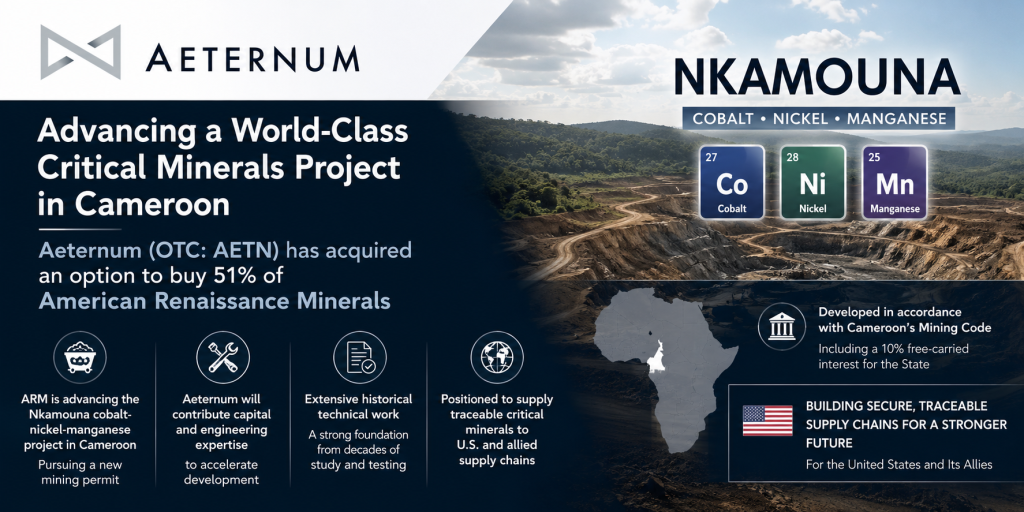
Nkamouna is one of the largest undeveloped cobalt-nickel-manganese projects globally. The project was fully permitted between 2003 and 2025 by Geovic Cameroon Plc, majority owned by Geovic Ltd. A lack of funding, and a permit approaching expiration, meant that Geovic was no longer able to pursue the project, and the permit was withdrawn in February 2025. ARM is working with the Government of Cameroon, including the Ministry of Mines, Industry and Technological Development and the Société Nationale des Mines, toward the award of a new mining permit, free of prior encumbrance, and is able to draw on the whole of the technical work already completed on the project. The large mining area covers approximately 1,650 km2, with an open-cut mining pit envisaged. ARM, in conjunction with Aeternum, intends to construct a concentrator at the mine site, similar in design to the plant that Aeternum is constructing in Nigeria, which is expected to be completed during 4Q 2026. Aeternum will contribute capital and engineering expertise to the development of the project, which is expected to shorten the path from study to production and to reduce execution risk.
In January 2026, ARM entered into an agreement with Geovic Ltd., the majority owner of Geovic Cameroon Plc, the prior holder of the Nkamouna permit, under which ARM licensed the whole of the historical technical information relating to the project, including the geological database, feasibility study, metallurgical testwork and environmental and social baseline studies. Under that agreement, Geovic will release all claims in respect of Nkamouna. The release of those claims removes the legacy exposure associated with the previous permit and allows a new permit to be issued free of prior encumbrance, while the licence preserves for the project the benefit of three decades of technical work already carried out in Cameroon.
The project will be developed in accordance with Cameroon’s Mining Code of December 2023, including the 10% free-carried interest of the State held through the Société Nationale des Mines. ARM and Aeternum intend to construct a concentrator at the mine site, producing an exportable cobalt-nickel-manganese concentrate rather than shipping unprocessed ore, so that the first stage of processing and its associated value are retained in Cameroon. The project is expected to support Cameroonian employment, technical training and local supplier development, together with programs for the communities in the project area, and ARM intends to develop it in partnership with Cameroonian shareholders and management.
Historical Mineral Resource Estimate
Nkamouna has been the subject of extensive historical technical work, including a feasibility study and an independent technical report. That report set out a historical estimate of 323 million tonnes grading 0.21% cobalt, 0.61% nickel and 1.26% manganese across the measured, indicated and inferred categories, of which approximately 121 million tonnes was classified as measured and indicated at grades of 0.23% cobalt, 0.65% nickel and 1.35% manganese. The historical estimate was prepared by a prior owner and was not prepared in accordance with subpart 1300 of Regulation S-K. A qualified person has not undertaken sufficient work to classify the historical estimate as a current mineral resource estimate, and neither the Company nor ARM is treating the historical estimate as a current mineral resource estimate. No assurance is given that the historical estimate will be confirmed by further work. It is presented in order to describe the technical base from which the Company and ARM intend to advance the project.
Nickel and Cobalt End Uses
Nickel is used principally in austenitic stainless steel, which accounts for approximately 65% of nickel consumption in the Western world, and in nickel-based superalloys and non-ferrous alloys, which account for a further 12% and are used in jet engine turbine blades and discs, land-based gas turbines and other high-temperature applications. The balance is used in alloy steels, electroplating, catalysts, chemicals and rechargeable batteries. Nickel is the largest metallic input by mass in nickel-manganese-cobalt lithium-ion cathodes, and battery applications are the fastest growing segment of nickel demand.
Cobalt is used in lithium-ion battery cathodes, where it improves thermal stability, cycle life and energy density, and in superalloys for aerospace and defense applications, which account for approximately half of United States cobalt consumption. Further applications include cemented carbides and cutting tools, catalysts used in petroleum refining and desulfurization, permanent magnets and pigments.
Supply and Demand Dynamics
Supply of both metals is highly concentrated. The Democratic Republic of the Congo accounted for approximately three quarters of world mined cobalt production in 2024, and China is the world’s leading producer of refined cobalt, most of which is produced from partially refined material imported from the Democratic Republic of the Congo. A material proportion of Congolese cobalt is produced artisanally, with associated labor and environmental concerns and limited chain-of-custody traceability, and this material is frequently blended with industrially mined production. Primary nickel supply has become similarly concentrated, with Indonesia now the dominant source of new supply and a significant proportion of that capacity Chinese-owned or Chinese-financed.
Independent forecasters expect demand for both metals to continue to grow, driven by electrification, grid-scale energy storage, aerospace and defense procurement and, more recently, the buildout of data center and artificial intelligence infrastructure. Existing mines are not expected to be able to expand capacity sufficiently to meet that demand, and the pipeline of exploration and development projects outside Chinese-influenced supply chains remains limited.
Strategic Importance to the United States
Nickel and cobalt are both included on the United States list of critical minerals. Net import reliance for cobalt has been approximately 76% in recent years, and the United States has only one operating nickel mine, with the result that, excluding recycled material, the United States would be almost wholly reliant on imports for its nickel supply. Both metals are essential to defense platforms, aerospace propulsion and energy storage, and the concentration of mine supply and refining capacity in a small number of jurisdictions presents a supply chain risk that has become an increasing policy concern for the United States and other Western governments.
Consistent with the strategy announced on August 4, 2026, the Company intends to develop Nkamouna to supply customers in the United States with traceable, responsibly produced units of cobalt, nickel and manganese for United States and allied supply chains.
ARM’s development of Nkamouna is supported by the advocacy program of the United States Government, through which United States agencies support United States commercial interests pursuing strategically significant projects overseas, and the project is regarded as being of strategic interest to the United States, both in national security terms and as a matter of economic and supply-chain interest. Support under that program does not constitute an endorsement of the Company, of ARM or of the transaction described in this release. The Company and ARM regard the project as being of equal importance to Cameroon, as a source of employment, public revenue, in-country processing capacity and long-term partnership between the two countries.
“Nkamouna is precisely the kind of asset our strategy was built for. It is a large, well-characterized critical minerals resource that has absorbed three decades of technical work, and has never been brought into production”, said Josua Oosthuizen, Chief Executive Officer of Aeternum. “Our team has spent the past year designing, manufacturing and installing a gravity separation plant for our Nigerian project. That capability, engineering and construction discipline applied to African orebodies, is what Nkamouna needs to move from study to production, and it is why we believe the combination of the two teams can materially shorten the path to first output”.
“Aeternum brings plant delivery and operating capability to Nkamouna at exactly the point in the project’s life where it is most needed”, said a spokesperson for American Renaissance Minerals. “With Geovic’s historical claims resolved and our work with the Government of Cameroon on the award of a new and unencumbered mining permit well advanced, this partnership gives the project a credible route to development and to supplying cobalt, nickel and manganese into United States supply chains”.
Transaction Details
The Option was acquired from Manaslu LLC, for 50,000,000 shares of common stock and 2,000,000 shares of Series B preferred stock, each share of which has the voting power of 40 shares of common stock.
ABOUT AETERNUM
Aeternum (OTC: AETN) seeks to become a highly strategic supplier of critical minerals. Its first resource is a mine located in the Jos Plateau in Nigeria that will focus on the production of tin, niobium, tantalum and other metals.
Led by a management team with a track record of designing, building and commissioning mineral-processing plants in Africa, and supported by independent geological and metallurgical consultants, Aeternum’s goal is to develop multiple assets globally and create a diversified revenue stream from several critical minerals.
FORWARD-LOOKING STATEMENTS
This press release contains forward-looking statements that are subject to various risks and uncertainties. These forward-looking statements include statements which may be accompanied by the words “intends,” “may,” “will,” “plans,” “expects,” “anticipates,” “projects,” “predicts,” “estimates,” “aims,” “believes,” “hopes,” “potential,” or other similar expressions. Although the Company believes that the expectations expressed in these forward-looking statements are reasonable, it cannot assure you that such expectations will turn out to be correct, and the Company cautions investors that actual results may differ materially from the anticipated results. Such factors include, among others, risks relating to the timing and ability of the Company to obtain and the timing of the approval of relevant regulatory bodies, if at all; risks relating to property interests; risks related to access to the project; risks inherent in mineral exploration, including the fact that any particular phase of exploration may be unsuccessful; the availability of contractors; geo-political risks; the global economic climate; metal prices; environmental risks; political risks; and community and non-governmental actions. Further to this, geological similarities or characteristics are not guarantees or certainties of successful exploration. Neither the Company nor any other person assumes responsibility for the accuracy and completeness of any such forward-looking statements. The Company does not undertake, and assumes no obligation, to update or revise any such forward-looking statements or forward-looking information contained herein to reflect new events or circumstances, except as may be required by law. The Company encourage readers to review the “Risk Factors” in our Form 8-K filed July 7, 2026, and other filings with the Securities and Exchange Commission for a comprehensive understanding.
For more information, please contact:
Aeternum
Investor Relations Department
Email: info@aeternumresources.com