



The Gigawatt Campus: How Microgrids are Rescuing the AI Revolution
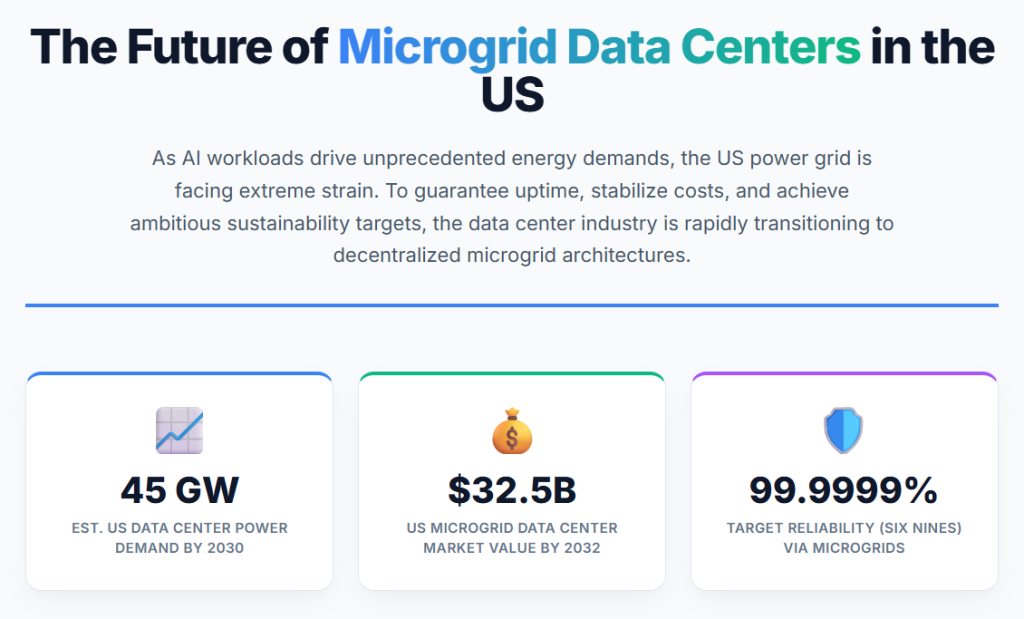
- Microgrids replace slow, unreliable utility dependence for AI growth
- Hybrid energy (gas + nuclear + storage) ensures 24/7 reliability
- Data centers evolve into energy producers via VPPs and arbitrage
PR Audio:
New York, New York, March 23, 2025 – – PRISM MediaWire (Press Release Service – Press Release Distribution) – The United States digital landscape is navigating a period of unprecedented structural evolution as the centralized power model reaches its breaking point. Driven by an exponential surge in artificial intelligence (AI) compute demand and a national electrical grid that has remained largely stagnant, the industry is shifting toward decentralized, behind-the-meter microgrid systems. This “speed-to-power” imperative has transformed electricity from a utility commodity into a strategic bottleneck. In the current competitive environment, securing high-density power independently is no longer an elective efficiency measure; it is a critical requirement for maintaining the pace of generative AI innovation, which is currently accelerating at 40% annually.
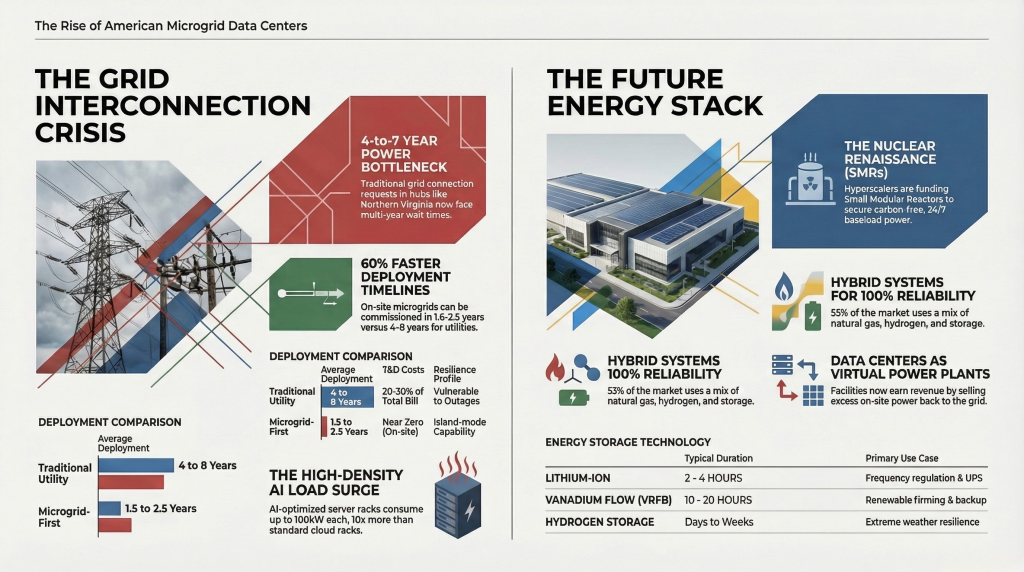
The following table synthesizes the “Interconnection Variable” data, contrasting the traditional utility-dependent model against the emergent microgrid-first approach:
| Interconnection Variable | Traditional Utility Model | Microgrid-First Model |
| Average Deployment Timeline | 4 to 7 Years | 1.5 to 2.5 Years |
| Transmission & Distribution Costs | 20-30% of Total Bill | Near Zero (On-site) |
| Capacity Certainty | High Risk of Curtailment | Full Control of Supply |
| Resilience Profile | Vulnerable to Grid Outages | Island-mode Capability |
This shift carries profound geopolitical weight. As wait times for grid connections in critical hubs like Northern Virginia stretch to seven years, the risk of “infrastructure flight” to international markets threatens U.S. leadership in AI. By establishing domestic power autonomy, hyperscalers ensure that the critical compute required for national security and semiconductor development—already subject to stringent export controls—remains within U.S. borders under sovereign control. This macro-economic necessity, however, is being met with significant engineering challenges as electrical architectures struggle to manage the unique, high-density demands of AI hardware.
Engineering the AI Power Interface: Managing High-Density Demand
The transition from standard cloud computing to AI-centric infrastructure has necessitated a radical redesign of the data center’s electrical interface. Unlike legacy workloads, AI training requires a massive intensification of power density that places unprecedented stress on electrical architecture. Conventional server racks drawing 7–10 kW are being replaced by AI-optimized racks consuming 30 to over 100 kW each, forcing a shift from passive energy consumption to an intelligent, adaptive ecosystem.
AI workloads are notoriously “lumpy,” characterized by sudden, massive power fluctuations that introduce complex technical challenges:
- Transient Dynamics: Large-scale GPU clusters can trigger power fluctuations of hundreds of megawatts within seconds.
- Subsynchronous Oscillations (SSO): These instabilities occur at frequencies below the 60 Hz fundamental. Traditional utility relays cannot respond fast enough to catch these oscillations, which can cause catastrophic equipment failure, including the destruction of power converters and transformer overheating.
To protect these sensitive IT loads, operators are turning to edge-based analytics, such as the Power Xpert quality (PXQ) framework. These systems utilize firmware-level innovations to enable:
- Real-time monitoring of the chip-to-grid interface at a granular level.
- Autonomous detection and mitigation of SSOs at the millisecond level.
- Automated system adjustments to generation and load before traditional utility protections can react.
As these high-density requirements push campuses toward the gigawatt level—equivalent to the output of two large nuclear reactors—developers are increasingly prioritizing massive, on-site generation sources to ensure operational continuity.
The Generation Stack: From Natural Gas Bridges to SMR Futures
To achieve 24/7 reliability while balancing cost and decarbonization, hyperscalers are adopting a “hybrid” approach to on-site generation. This strategy prioritizes “firm” baseload power to ensure that multi-billion dollar capital investments in GPU clusters are never left idle due to energy intermittency.
Natural gas serves as the primary “bridge fuel” due to its ability to reach full load within minutes to manage spiky AI demands. The efficiency of these systems is maximized through Combined Heat and Power (CHP) configurations:
- Thermal Recycling: Waste heat from generation is captured for absorption cooling, significantly lowering the facility’s Power Usage Effectiveness (PUE).
- Operational Savings: CHP integration can raise total system efficiency to 60–80%, reducing operational costs by 5% to 20% compared to standard utility rates.
For long-term carbon-free power, tech giants have pivoted from being mere buyers of energy to becoming primary financiers and developers of nuclear infrastructure.
| SMR Developer | Reactor Technology | Capacity per Module | Key Characteristics |
| X-energy | Xe-100 (High-Temp Gas) | 80 MWe | “Meltdown-proof” TRISO fuel; Amazon partner |
| NuScale Power | VOYGR (Light Water) | 77 MWe | NRC certified design |
| Oklo | Aurora (Fast Reactor) | 15–100 MWe | Recycles spent fuel; 2027 target |
| GE Hitachi | BWRX-300 (Light Water) | 300 MWe | Simplified passive cooling |
| Kairos Power | Hermes (Molten Salt) | 140 MWe | Fluoride salt-cooled; Google PPA |
Furthermore, a strategic synergy is emerging between Small Modular Reactors (SMRs) and hydrogen production. High-temperature steam from advanced reactors can drive electrolysis, producing green hydrogen at costs potentially below USD 2/kg. In this model, the data center acts as an anchor customer for localized “hydrogen hubs,” using the gas for both variable workload buffering and long-term backup. These diverse generation sources require advanced storage technologies to firm these assets for continuous uptime.
Beyond Lithium: The Dawn of Long-Duration Energy Storage (LDES)
In a 24/7 uptime environment, the strategic role of energy storage is shifting from short-term stabilization to multi-day resilience. While lithium-ion remains the standard for immediate UPS needs, it is ill-suited for the multi-day discharge required to bridge gaps in renewable generation or extended outages.
Vanadium Redox Flow Batteries (VRFBs) are emerging as a superior alternative for long-duration applications. Their technical advantages include:
- Independent Scaling: Power (MW) and energy (MWh) scale separately by increasing electrolyte tank volume.
- Extended Lifecycle: 30-year operational life with virtually no degradation.
- Non-flammability: Liquid electrolytes eliminate fire risks in high-density campuses.
- Discharge Duration: VRFBs provide 10–20 hours of continuous discharge capability.
| Storage Technology | Duration | Lifecycle/Degradation | Primary Use Case |
| Lithium-ion | 2–4 Hours | 10 years / Significant | Frequency regulation, UPS |
| Vanadium Flow (VRFB) | 10–20 Hours | 30 years / Minimal | Renewable firming, backup |
| Thermal (Bricks/Salt) | 8–15 Hours | 30+ years / Near zero | Cooling load shifting |
| Hydrogen Storage | Days to Weeks | N/A (Fuel based) | Extreme weather resilience |
As these assets mature, they are being integrated into new economic models that transform data centers from cost centers into active revenue streams.
The New Economics of Power: LCOE, VPPs, and Grid Arbitrage
The financial architecture of modern microgrids is reaching a tipping point where self-generation often outperforms traditional utility agreements in congested Regional Transmission Organizations (RTOs) like PJM. The Levelized Cost of Electricity (LCOE) for on-site systems has reached parity with or improved upon utility rates in many markets.
A hybrid microgrid (solar, storage, and natural gas) can achieve an LCOE between USD 87–109/MWh. This is notably lower than peak wholesale rates in PJM, which exceeded USD 212/MWh in mid-2025. It also remains competitive with new nuclear restarts, such as the Microsoft/Three Mile Island deal priced near USD 130/MWh. Critically, for 24/7 “firmness,” renewable-only systems face a cost penalty of 60% or more, which is why natural gas and nuclear remain the primary baseload components of the microgrid stack.
Data centers are also adopting the “Data Center-funded, Utility-managed VPP” model to maximize these assets. This creates a strategic “quid pro quo”:
- Expedited Interconnection: Developers may fund local Virtual Power Plants (VPPs) in exchange for faster grid connection rights from the utility.
- Grid Arbitrage: During peak stress, data centers switch to on-site generation and curtail grid draw, effectively selling capacity back to the utility.
These models are necessary to navigate a regulatory landscape that is becoming increasingly supportive at the federal level while facing resistance in specific states.
Navigating the Regulatory Minefield: Federal Support vs. State Resistance

There is a growing tension between federal incentives designed to spur tech innovation and state-level “energy accountability” mandates. While federal policy seeks to accelerate microgrid deployment, many states are acting to ensure data center demand does not burden residential ratepayers.
On the federal side, the Inflation Reduction Act (IRA) provides a 30% Investment Tax Credit for microgrid controllers and energy storage. Simultaneously, FERC Order 2023 aims to reform the interconnection process. However, state-level actions are creating a patchwork of local requirements:
| State | Legislative Action | Key Requirement | Impact on Microgrids |
| Illinois | POWER Act (SB4016) | “Bring Your Own Clean Energy” | High; mandates on-site BESS/renewables |
| West Virginia | HB 2014 | Certified Microgrid Districts | High; encourages off-grid clusters |
| Texas | Senate Bill 6 | Cost-sharing for T&D | High; eliminates grid subsidies |
| Virginia | HB 961 / HB 897 | Emission-free Backup | High; forces shift from Diesel |
| Utah | SB 132 | Competitive Market Access | High; allows third-party generation |
| Maryland | SB 937 | Large Load Standards | Moderate; sets direct-connect rules |
This regulatory shift toward accountability makes the case for behind-the-meter microgrids undeniable, yet operational risks remain the final gatekeepers.
7. Strategic Challenges: Cybersecurity, Supply Chains, and Talent
Despite the technical and economic promise, the pace of development is constrained by systemic vulnerabilities:
- Cybersecurity of Intelligent Grids: As microgrids become digitally integrated, breaches in control systems could allow adversaries to physically damage generation assets. Protection requires zero-trust architectures integrated directly into power management software.
- Supply Chain Bottlenecks: Advanced generation is stalled by a “thin” supply chain. SMR development is hampered by the lack of domestic High-Assay Low-Enriched Uranium (HALEU) fuel, while lead times for transformers often rival grid interconnection delays.
- Talent Scarcity: There is a critical shortage of professionals capable of building these hybrid systems. The industry now requires nuclear engineers and civil engineers familiar with “nuclear-grade” seismic standards—a specialized workforce that currently does not exist in sufficient numbers.
Final Statement: The Data Center as an Active Grid Participant
The data center is evolving from a passive consumer into a self-sustaining, grid-interactive energy hub. By 2030, 30% of all new sites are projected to incorporate microgrids, essentially decoupling the growth of the American digital economy from the limitations of the national grid.
The broader impact of this $200 billion annual investment will be the commercialization of next-generation clean energy, from SMRs to long-duration storage. As these facilities become “grid-interactive,” they will provide essential services like peak-shaving, ultimately improving the reliability of the entire U.S. electrical system. The gigawatt campus of the future will serve as both the computational and electrical foundation for the next century of American innovation.
FAQ:
What is the significance of microgrids in supporting the AI revolution?
Microgrids are crucial in supporting the AI revolution by providing decentralized, resilient, and high-density power sources that ensure continuous operation of AI hardware, especially as traditional grids face delays and limitations.
How do high-density power demands affect data center electrical architecture?
High-density power demands from AI workloads require a radical redesign of data center electrical systems, including intelligent, adaptive energy ecosystems and real-time management to handle sudden power fluctuations and instabilities such as Subsynchronous Oscillations.
What role do Small Modular Reactors (SMRs) play in powering microgrids for data centers?
SMRs serve as long-term, carbon-free power sources, often integrated with hydrogen production, to provide reliable, on-demand energy that supports the high-density and continuous operation needs of AI-focused data centers.
Why is long-duration energy storage important for modern data centers?
Long-duration energy storage, like Vanadium Redox Flow Batteries, is essential for maintaining 24/7 uptime by bridging renewable energy gaps and extended outages, offering hours to days of discharge and enhancing resilience.
What are the challenges faced in expanding microgrid deployment for business data centers?
Challenges include cybersecurity risks, supply chain bottlenecks for critical components, shortages of skilled talent, and navigating complex regulatory environments at federal and state levels.
About PRISM MediaWire
PRISM MediaWire is a New York City–based press release distribution company specializing in capital markets communications for publicly traded companies. The company provides direct access to Tier 1 financial media outlets, leading brokerage platforms, and targeted industry channels to ensure maximum investor exposure and market visibility. Serving companies listed on NASDAQ, NYSE, and OTC Markets, PRISM MediaWire delivers strategic distribution, unlimited word count, complimentary multimedia integration, competitive pricing, and 24/7 dedicated support. Its results-driven approach helps issuers strengthen shareholder communication, enhance credibility, and maintain a consistent presence in today’s competitive financial markets.
Contact Information:
PRISM MediaWire
110 East 59th Street, 23rd Floor
New York, NY 10022
📞 Phone: 646-780-8850
📞 Phone: 646-863-7997
📧 Email: info@prismmediawire.com, twolff@prismmediawire.com
🌐 Website: https://prismmediawire.com
PRISM MediaWire Bio Link: https://linktr.ee/prismmediawire
PRISM MediaWire Newsroom Overview: https://tinyurl.com/pmwnewsroom
PRISM MediaWire RSS Feed: https://prismmediawire.com/feed
PRISM MediaWire GPT: PRISM MediaWire GPT
Follow PRISM MediaWire on Social Media:
X (formerly Twitter): https://x.com/prism_mediawire
Facebook: https://www.facebook.com/prismmediawire
Threads: https://www.threads.com/@prismmediawire
Pinterest: https://www.pinterest.com/prismmediawire
Instagram: https://www.instagram.com/prismmediawire/
Google Business Profile: https://share.google/sS9U6VBoDkBB2vBIi
Bluesky: https://bsky.app/profile/prismmediawire.bsky.social
PRISM MediaWire on Newsramp: https://newsramp.com/newswire/prism
PRISM MediaWire Slack Community: prismmediawire.slack.com
PMW on Newsramp: https://newsramp.com/newswire/prism
Add us on Google as a Preferred Source to see more News in your Search Results
The Rise of American Microgrid Data Centers – The Gigawatt Campus: How Microgrids are Rescuing the AI Revolution – by @prism_mediawire https://t.co/yzfddsIeLI pic.twitter.com/CoG0sNGvbS
— PRISM MediaWire (@prism_mediawire) March 23, 2026
Source: PRISM MediaWire
— PRISM MediaWire (@prism_mediawire) October 16, 2025
Share: